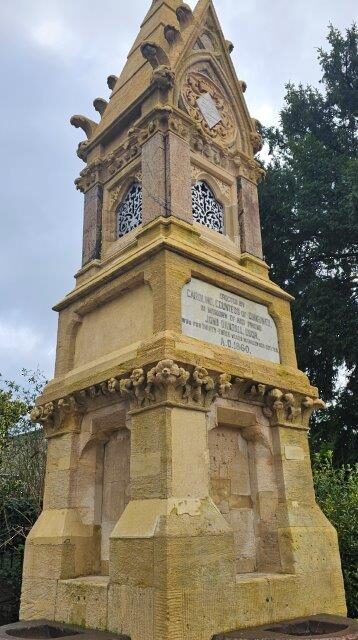
In the Bridgend town centre, quietly enclosed behind its railings and framed by greenery, stands a striking piece of Victorian civic pride – the Randall Memorial.
At first glance it is simply an ornate Gothic drinking fountain. Look a little closer, however, and it reveals a layered story of estate stewardship, industrial growth, early photography and the enduring relationship between the Dunraven family and the people of Bridgend.
Dating from 1860, the Randall Memorial is Grade II listed and remains one of the oldest surviving historic features in Bridgend town centre.
Built in gratitude
The memorial was commissioned by Caroline, Countess of Dunraven, in memory of John Randall, who became land agent to the Dunraven Estate in 1826.
Originally from Salisbury, Randall oversaw the estate for 33 years during a period of significant development in Glamorgan. Under his professional and farsighted management, the estate prospered for the benefit of both landlord and tenants. When he died in 1859, the Countess commissioned this Gothic drinking fountain as a permanent tribute to his loyalty and service.
It was not the end of the Randall connection. His son Henry succeeded him and continued in post for a further 49 years, until 1908. Another son, John Morgan Randall, later also served as land agent. In total, the Dunraven Estate remained under the stewardship of a father and his two sons for more than a century – an extraordinary continuity in Welsh land management history.
A symbol of Victorian civic progress
Public drinking fountains were not merely decorative in the mid-19th century. They formed part of a wider public health movement, emerging at a time when access to clean water was becoming recognised as essential to urban wellbeing.
To install such a fountain in the centre of Bridgend was both practical and symbolic. It reflected the civic confidence of a town developing alongside the coal and iron industries, and the influence of estates such as Dunraven in shaping its infrastructure.
Architecturally, the memorial adopts the Gothic Revival style popular at the time – with carved detailing and heraldic references linking it firmly to the Wyndham-Quin family, Earls of Dunraven and Mount-Earl and Barons of Adare. The family’s Irish lineage and long-standing Glamorgan connections are explained on the interpretation panel at the site, offering visitors insight into the broader historical framework behind the monument.
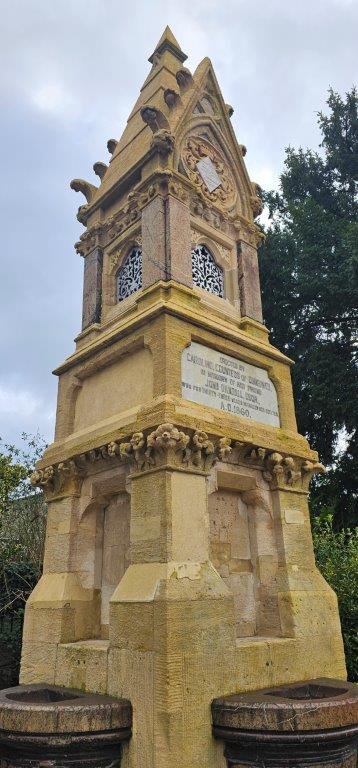
Photograph copyright Mark Roberts 2026
Captured at the dawn of photography
One of the most intriguing details associated with the Randall Memorial is the photograph taken at its unveiling ceremony in 1860.
William Henry Fox Talbot (1806 – 1877), pioneer of early photographic printing processes, developed his groundbreaking method in 1841. The unveiling image of the memorial was produced only 19 years later – making it a remarkably early photographic record of a civic event in Bridgend.
The Talbot family’s connection to Margam Abbey – and the naming of neighbouring Port Talbot – adds yet another layer of regional history to the story.
Restoration and renewal
As part of Bridgend town centre’s regeneration programme, the memorial was carefully restored under the custodianship of Bridgend Town Council. It was re-dedicated to the residents of Bridgend in Spring 2006 by the 7th Earl of Dunraven. Today, it remains both a decorative focal point and a quiet reminder of continuity – of estate management spanning generations, of Victorian civic ambition, and of a town shaped by industry, land and loyalty.
Why it still matters
It would be easy to pass the Randall Memorial without noticing its depth. Yet it represents over 100 years of stewardship, a gesture of gratitude carved in stone, and one of the earliest photographic records of Bridgend life.
In a town centre that continues to evolve, the Randall Memorial stands steady – not simply as an object of heritage, but as part of Bridgend’s living story.
…
Love Bridgend?
Check out Bridgend Life’s Facebook page at www.facebook.com/bridgendlife
…